
Trauma Therapy | Racial Trauma Counseling
Racial trauma is not a metaphor. It is a clinical reality — one that changes how the nervous system operates, how attachment develops, how the body holds stress, and how a person moves through spaces that were not designed to include them. It shows up in relationships, in sleep, in the decisions made under pressure, and in the quiet exhaustion of being the only one in the room who has to calculate the cost of being seen.
Sterling Counseling offers racial trauma therapy and culturally truthful trauma counseling for BIPOC professionals who are ready to address what systemic racism, intersectional oppression, and the cost of being the exception have cost them clinically. If you are looking for trauma therapy that treats racial trauma as a clinical variable rather than a side conversation, you are in the right place. Below we explore what racial trauma looks like, how it is treated here, and what becomes possible when the full picture is finally addressed.
What is racial trauma?
Racial trauma, also referred to as race-based traumatic stress, is the psychological and physiological injury caused by exposure to racism — including direct experiences of discrimination, microaggressions, racial violence, systemic exclusion, and the chronic stress of navigating spaces that treat your presence as conditional or inferior. Unlike single-incident trauma, racial trauma is cumulative and ongoing. It does not resolve when the incident ends. It compounds over time in the nervous system, in the body, and in the relational patterns that develop as a result of sustained exposure. Racial trauma therapy at Sterling Counseling treats this as the serious clinical matter it is.
Common signs of racial trauma
- Hypervigilance in predominantly white spaces — a chronic state of threat monitoring that persists even when there is no immediate incident.
- Emotional numbing or detachment following racial incidents or microaggressions, particularly those that occurred in professional settings where a reaction would have had consequences.
- Difficulty trusting people outside your racial or cultural community, or feeling the need to perform a version of yourself that is more palatable to others.
- Somatic symptoms: chronic tension, disrupted sleep, fatigue, or physical digestive and gastrointestinal issues and other responses to racial stressors that the body has been absorbing for years.
- Internalized self-doubt about your competence, your belonging, or your right to take up space — particularly in rooms where you are the exception.
- A persistent sense of exhaustion that is not explained by workload alone.
How do you know if racial trauma is affecting you?
- Do you find yourself calculating how you will be perceived before you speak in certain rooms, regardless of your credentials? This constant threat-monitoring is a hallmark of racial trauma's impact on the nervous system.
- Do racial incidents at work — microaggressions, exclusions, moments of being talked over or dismissed — stay with you longer than you think they should? The nervous system does not distinguish between a slur and a subtle dismissal. It responds to both as threat.
- Do you carry a sense of chronic vigilance that others around you seem not to share? The weight of being watched, evaluated, or tokenized changes how the body holds stress.
- Has the experience of being the exception in your field shaped your sense of identity in ways you have not had language for? Racial trauma therapy gives you that language and addresses what is underneath it.
- Do you often struggle with self-confidence or second-guessing your contributions in professional, predominantly white, settings? Social Psychologists Claude Steele and Joshua Aronson relate these experiences to stereotype threat, the persistent internal weight of fearing that your performance will validate harmful biases or systemic prejudices against your community. Racial Trauma therapy affirms these experiences while minimizing the associated anxiety and increasing self-confidence with awareness.
Who this work is built for
This work may be a strong fit for BIPOC professionals who are experiencing the cumulative effects of racial trauma, intersectional oppression, or the chronic stress of navigating predominantly white or hostile professional environments. It is particularly suited to those who have sought therapy before and found that their racial experience was minimized, explained around, or treated as incidental rather than central to the clinical picture. This approach may not be the best fit if you are in an immediate safety crisis or require a level of psychiatric support beyond what outpatient therapy provides.
How racial trauma therapy works at Sterling Counseling
The foundational commitment of racial trauma therapy at Sterling Counseling is that systemic racism is a clinical variable, not a side topic. This means it is not treated as context to be acknowledged and set aside — it is treated as load-bearing material that shapes how trauma is formed, how it presents, and how it is most effectively addressed. Racial trauma therapy here is evidence-based, culturally truthful, and built around your specific experience rather than a generalized protocol.
Treatment draws on EMDR, Trauma Focused CBT, Attachment-Based Therapy, Emotion-Focused Therapy, and somatic approaches. For racial trauma specifically, EMDR is often particularly effective because it processes traumatic memories at the level where they are stored — in the body and the nervous system — rather than requiring a verbal account of each incident. Sessions are tailored to what your specific racial trauma history requires, not a standardized treatment plan applied uniformly.
Progress in racial trauma therapy often shows up as reduced hypervigilance, decreased somatic activation in response to racial stressors, a clearer sense of identity that is less defined by the rooms that have questioned it, and an increased capacity to respond rather than react in the professional and relational contexts where racial trauma has been most active.
What working together looks like
We begin with a consultation and intake to establish the clinical picture — your racial trauma history, the contexts in which it has been most activated, what you are carrying somatically, and what you want from the work. Sessions are 55 minutes, conducted virtually, and paced based on what your nervous system is ready for. Racial trauma therapy does not rush toward the hardest material. It builds the clinical container first, then works at the depth the work requires.
How it works:
Reach out
Fill out the contact form and let us know what brought you here. You do not have to have the full picture articulated before you reach out.
Schedule your consultation
We will set up a free 15-minute consultation to explore fit and talk through what racial trauma therapy at Sterling would look like for your specific experience.
Begin the work
Your intake session is where we map the full clinical picture and establish the direction for the work. The context you usually have to explain before therapy can begin is the floor we start on here.
Meet your therapist

Olivia Sterling, LCSW, is an Afro-Latina, Columbia-trained clinician with over twelve years of experience treating racial trauma, intersectional identity, and the clinical impact of systemic racism on BIPOC professionals. She holds certifications in EMDR and Trauma Focused CBT, and her approach treats racial trauma as the central clinical variable it is — not a detail to acknowledge before moving on to something else. The context you have spent your career translating is the clinical floor she starts on. Defying impossible odds got you here. The work here addresses what that costs.
What we can work on in racial trauma therapy
- Processing specific racial incidents, microaggressions, and discriminatory experiences that are still active in the nervous system
- Reducing hypervigilance and the chronic threat-monitoring that racial trauma produces
- Addressing internalized racism and the self-doubt that sustained exposure to exclusion can generate
- Working with the somatic record of racial trauma — what the body has been holding
- Building a sense of identity and belonging that is not contingent on the approval of rooms not built for you
- Processing collective and ancestral racial grief
- Addressing the clinical impact of code-switching and the sustained performance of acceptability
While you consider whether this work is right for you
- Notice when your nervous system activates in response to racial stressors — not just the major incidents, but the small ones that accumulate. The body keeps a running count even when the mind has moved on.
- Understand that the exhaustion you carry after navigating predominantly white or hostile spaces is physiological, not personal weakness. It is the cost of sustained threat-monitoring.
- If you have sought therapy before and found that your racial experience was treated as peripheral rather than central, that is not evidence that therapy cannot help you — it is evidence that you had the wrong therapist.
- Connecting with community — whether personal, professional, or cultural — is one of the most consistently supported protective factors against the cumulative impact of racial trauma.

Olivia Sterling
Licensed Clinical Social Worker and founder of
Sterling Counseling, PLLC.
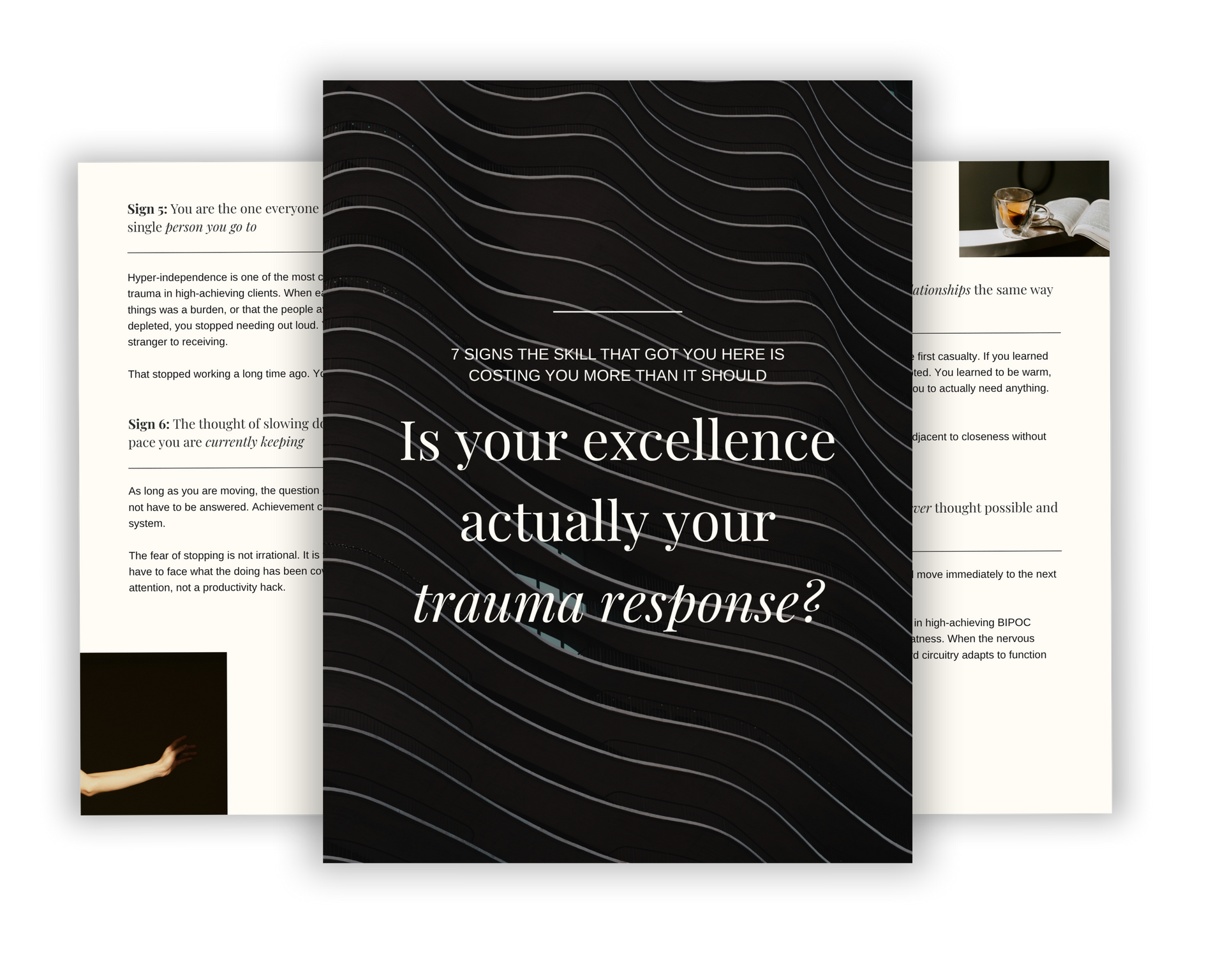
I believe the drive, resilience, and excellence that carried you here are real skills. The work is what it looks like to refine them into a life you get to live with integrity.
Investment
- Free 15-minute consultation via Telehealth video
- Intake session (20+ minutes): $250
- Follow-up sessions (55 minutes): $225
Frequently Asked Questions
What is racial trauma therapy?
Racial trauma therapy is evidence-based clinical treatment specifically designed to address the psychological and physiological impact of racism and racial discrimination. It differs from general trauma therapy in that it treats systemic racism, microaggressions, racial violence, and intersectional oppression as primary clinical variables — not context to be noted and moved past. At Sterling Counseling, racial trauma therapy integrates EMDR, Trauma Focused CBT, somatic approaches, and Attachment-Based Therapy to address racial trauma at the level where it actually lives: in the nervous system, the body, and the relational patterns shaped by sustained exposure to racism.
What are the symptoms of racial trauma?
Symptoms of racial trauma include hypervigilance in racialized spaces, intrusive memories of racial incidents, emotional numbing following discrimination, chronic fatigue and somatic complaints (tension, sleep disruption, headaches), difficulty trusting people outside your racial or cultural community, internalized self-doubt about competence or belonging, and a persistent sense of exhaustion that workload alone does not explain. These symptoms are consistent with the diagnostic criteria for post-traumatic stress and require the same level of clinical attention.
How do I know if I have racial trauma?
If you experience persistent activation, vigilance, or physical responses in response to racial stressors — even subtle ones — and if those responses are affecting your relationships, your work, your sleep, or your sense of self, racial trauma is likely part of the clinical picture. Many people who carry racial trauma have never named it as such because most therapy spaces have not given it that name. If you have ever left a therapy session feeling like your racial experience was explained around rather than worked with, that is a meaningful signal worth exploring.
What is the best therapy for racial trauma?
Research supports several modalities for racial trauma, including EMDR, Trauma Focused CBT, and Emotion-Focused approaches. EMDR is particularly effective for racial trauma because it processes the traumatic material at the nervous system level rather than requiring detailed verbal recounting of each incident. At Sterling Counseling, treatment is tailored to each client's specific racial trauma history and presentation rather than applied uniformly, which research consistently identifies as a key factor in treatment effectiveness for race-based stress.
How long does racial trauma therapy take?
The timeline for racial trauma therapy depends on the complexity and chronicity of the racial trauma, what is being addressed, and how it has intersected with other clinical presentations like attachment wounds or depression. Racial trauma that is cumulative and longstanding typically requires more time than single-incident trauma. At Sterling Counseling, the pace of the work is set by what your specific clinical picture requires — not a predetermined number of sessions. Progress is assessed collaboratively and the work continues as long as there is meaningful clinical ground to cover.